SEO for online stores that sell to other businesses: wholesalers, distributors, manufacturers and trade suppliers.
Prices are often hidden, catalogues sit behind logins, buyers search by part number, and sales close
through quotes weeks later. We build for that: indexable part-number pages, a clear rule on what stays
public, and reporting that follows the buyer to the account.
Trade pricing for account holdersLog in or apply for an account
Request a quote
Illustrative: a B2B product page can rank without showing its price.
Search Console is the scoreboard
One search intent, one page
Implementation, not just recommendations
No guaranteed rankings, from us or anyone
Why retail ecommerce SEO advice breaks on B2B stores
Most ecommerce SEO advice assumes an open catalogue, visible prices and a purchase that can finish
in one session. B2B stores routinely have none of those, so the standard playbook transfers badly.
What B2B stores do have is unusually precise search behaviour. A buyer who types a manufacturer
part number or a full specification already knows what they need. Those searches are low in volume
and very high in intent, and most B2B competitors leave them unanswered.
The last row is the one that trips people up. A part number searched 20 times a month can be worth
more than a category term searched 2,000 times, if one of those 20 becomes a trade account that
orders every month. Volume is the wrong number to judge B2B search by. Value per visit is the right
one.
Retail (B2C) ecommerce
B2B ecommerce
How buyers search
Descriptive and brand terms ("black running shoes")
Part numbers, specs, standards, compatibility ("M12 316 stainless hex bolt")
Pricing
Visible on the page
Often hidden, tiered by account, or quote-only
Catalogue access
Fully public
Partly or fully behind a trade login
Conversion
Checkout
Quote request, account application, repeat order
Who decides
One person
Often a buyer, a technical approver and finance
Sales cycle
Minutes to days
Weeks to months, then repeat orders for years
What to measure
Revenue per session
Quotes, accounts opened and account value over time
Search volume per term
Can be high
Usually low, but each visit can be worth far more
Who B2B ecommerce SEO suits
This service suits stores where the catalogue is technical and the account is worth more than the
order. It's the wrong fit if search can't see anything you sell, or if you need attributable revenue
inside one quarter.
A good fit
A good fit if
You sell to trade, wholesale, industrial or institutional buyers
Your products have part numbers, SKUs or technical specifications
A trade account is worth far more than a single order
Quotes, account applications and repeat orders matter more than checkout
You sell, or want to sell, to buyers across Australia rather than one city
Probably not a fit
Probably not a fit if
Your entire catalogue is behind a login and you won't expose any of it
You can't connect an enquiry to its source in any system at all
You need results within a quarter, which a B2B buying cycle rarely allows
The Catalogue Exposure Model: what to show publicly and what to keep behind login
The biggest decision in B2B ecommerce SEO is what your catalogue shows to the public. Googlebot
doesn't log in, so anything only visible to account holders can't rank. Hiding everything protects
pricing but makes you invisible to new buyers. Showing everything can undercut your account terms.
We resolve that with a simple model. Each type of product information is rated Public, Partial or
Private, based on its search value and its commercial risk. This is our working method, not an
industry standard, and the right answer varies by business.
Public
Product name and brand
Manufacturer part number and your SKU
Full specifications (size, material, rating, tolerance)
Standards and certifications
Compatibility and replacement information
Datasheets and spec sheets
Partial
Stock availability
Minimum order quantity and pack sizes
List price or RRP
Private
Account, tiered and contract pricing
Customer-specific catalogues and reorder lists
The Catalogue Exposure Model sorts product data by search value and commercial risk.
Product information
Default rating
Why
SEO effect
Product name and brand
Public
Needed for any page to rank
Matches brand and product searches
Manufacturer part number and your SKU
Public
The highest-intent searches in B2B
Captures exact part-number queries
Full specifications (size, material, rating, tolerance)
Public
Buyers filter and compare on these
Matches specification searches and long-tail variants
Standards and certifications
Public
Buyers often search by the standard
Matches compliance and standard-number searches
Compatibility and replacement information
Public
Answers "fits" and "replaces" searches
Captures replacement-part demand
Datasheets and spec sheets
Public, as HTML plus a PDF download
PDF-only content is weaker as a landing page
Makes technical content crawlable and linkable
Stock availability
Partial ("In stock", "Made to order")
Signals reliability without exposing quantities
Supports conversion, low commercial risk
Minimum order quantity and pack sizes
Partial
Qualifies buyers before they enquire
Fewer wasted quotes
List price or RRP
Partial, your choice
Some sectors publish it, others never do
Can help shopping-style results if shown
Account, tiered and contract pricing
Private
This is your commercial advantage
No SEO cost to keeping it private
Customer-specific catalogues and reorder lists
Private
Belongs to the account
No SEO cost to keeping it private
A common cause of an undersized public catalogue is a blanket login wall that also hides part numbers
and specifications, which carry no pricing risk at all.
What our B2B ecommerce SEO service includes
Each engagement draws on the workstreams below. The audit decides which ones your store needs, so you
don't pay for a fixed package of work nobody needed.
01
Part-number and specification search
Make part numbers, codes and specs indexable, matched to how buyers type them.
What you getA part-number and specification keyword map tied to specific URLs and templates.
Read more
We make part numbers, manufacturer codes, specifications and compatibility data indexable and matched to how buyers type them, including common formatting variants (with and without dashes or spaces). These searches convert well and most competitors ignore them.
02
Gated catalogue strategy
Let search see your products while account pricing stays private.
What you getAn exposure plan your sales team and developer both sign off.
Read more
We apply the Catalogue Exposure Model to your store, so search can see your products while account pricing stays private.
03
Product data and manufacturer descriptions
Add the information only you hold, across every template.
What you getProduct and category templates that make every page distinct, applied across the catalogue rather than one page at a time.
Read more
Distributors often use the same manufacturer descriptions as every other reseller of that brand, so Google has little reason to prefer your page. We fix the template and the data, adding the information only you hold: stock location, pack sizes, applications, compatible parts and lead times.
04
Faceted navigation and crawl control
Decide which specification filters deserve pages; block the rest.
What you getA filter indexation plan and crawl rules your developer can implement.
Read more
Specification filters (size, material, thread, voltage, finish) can create millions of near-duplicate URLs. Google's own documentation warns that crawlers can spend a large share of their visits on filtered URLs before working out they aren't useful, which slows the discovery of new products. We decide which filter combinations deserve indexable pages and block or consolidate the rest.
Turn spec sheets and guides into crawlable pages that link to products.
What you getA documentation content plan, prioritised by search demand.
Read more
Spec sheets, installation guides, compatibility tables and standards explainers are genuinely useful to buyers, and most competitors bury them in PDFs. We turn them into crawlable HTML pages that link back to the products.
06
Enquiry-led conversion
Build pages around quote requests and trade account applications.
What you getConversion paths that send qualified enquiries to your sales team with the context they need.
Read more
In B2B, a quote request or a trade account application is the conversion. We build product and category pages around those actions, with clear trade-pricing prompts, quote forms that capture the part number, and account application paths that don't lose buyers.
07
Structured data that matches what's visible
Product, Organization and Breadcrumb markup, with no invented prices.
What you getValidated structured data across product and category templates.
Read more
We add Product, Organization and Breadcrumb markup that reflects what's actually on the page. If a price isn't shown publicly, it isn't invented in the markup, because structured data has to match visible content.
Give search credit for the accounts it starts, not only one-session orders.
What you getA reporting setup that tracks part-number visibility, quote requests and accounts opened.
Read more
We connect Search Console, your analytics and your CRM or order system, so search gets credit for the accounts it starts, not only the orders it closes in one session.
Worked example: anatomy of a B2B product page that can rank
Here's how we'd structure one product page on a fastener distributor's store. The product and business
are illustrative, not a client, but the structure is the one we'd recommend.
The product: a 316 stainless steel hex bolt, M12 thread, 50 mm long, sold in boxes of 50 to trade accounts only.
The searches it should match: the manufacturer part number in several formats, "M12 x 50 316 stainless hex bolt", "M12 stainless bolt 50mm", and the relevant standard number.
1/products/hex-bolt-m12-50-316-stainless/
2M12 x 50 mm hex bolt, 316 stainless steel (HB-M12-50-316)
3
Thread M12Length 50 mm316 stainlessHex headPlain finishBox of 50
4
Trade pricing for account holders. Log in or apply for an account.
5Request a quote · HB-M12-50-316 · Box of 50
Each element on a B2B product page has a search or conversion job: 1 URL, 2 H1, 3 specification table, 4 trade pricing block, 5 quote button.
Leads with the spec buyers type, includes the part number
H1
M12 x 50 mm hex bolt, 316 stainless steel ([part number])
Matches the spec search and the part-number search
Specification table
Thread, length, material grade, head type, finish, standard, pack size
Matches long-tail spec searches; scannable for buyers
Part number variants
Manufacturer code with and without dashes, your SKU, superseded codes
Captures every way the code gets typed
Compatibility
Matching nuts and washers, linked
Internal links to related products; answers "what fits"
Pricing block
"Trade pricing for account holders. Log in or apply for an account."
Price stays private, the page still converts
Quote button
"Request a quote" form that pre-fills the part number and pack size
Quote is the conversion; sales gets the context
Availability
"In stock, ships from [warehouse state]"
Partial information builds trust without exposing quantities
Datasheet
HTML spec summary on the page, plus a PDF download
Crawlable content plus the file buyers need
Breadcrumb
Fasteners > Bolts > Hex bolts > Stainless
Clear hierarchy for buyers and crawlers
Structured data
Product with name, SKU, MPN, brand, image; no invented price
Matches what's visible
Applied as a template, this structure improves every product in the catalogue at once. On a distributor
with 8,000 products, that's the difference between 8,000 individual rewrites and one template change plus
clean product data.
Nationwide B2B ecommerce SEO: selling to buyers across Australia
Most B2B stores sell well beyond their home city, so their search strategy has to work nationally.
Nationwide B2B ecommerce SEO means ranking for searches from buyers in every state, not just where your
office or warehouse sits.
That changes the work in four ways
National intent is different from local intent. A buyer searching for a part number rarely adds a city. Your product and category pages compete nationally by default, so they carry most of the weight.
Location pages only where you're really located. Warehouse, branch and trade-counter pages earn their place when there's a real address, stock and pickup behind them. Near-identical city pages with swapped place names are the kind of doorway pattern Google's spam policies warn against.
Delivery and freight information is content. Buyers outside your state want to know dispatch times, freight zones and delivery costs before they enquire. A clear delivery page per region, or a freight table, answers that and supports "supplier Australia" searches.
"Supplier", "wholesale" and "distributor" modifiers. Searches such as "[product] supplier Australia" or "[brand] distributor" signal a buyer looking for an account. Category pages should answer them directly.
The SEO principles stay the same across platforms. The limits each platform imposes on URLs, canonical
tags, filtered pages and gated content are what change.
Platform
Typical B2B setup
SEO points to check
Shopify and Shopify Plus
Native B2B features or wholesale apps
Fixed URL structures, collection duplicates, app-generated pages. See Shopify SEO
WooCommerce
Wholesale and role-based pricing plugins
Plugin-created duplicate pages, filter URLs, speed. See WordPress SEO
Public, Partial and Private decisions for each data type, agreed with your sales team
Weeks 2 to 3
Keyword-to-URL map
Category, specification and part-number search patterns mapped to templates and pages
Weeks 3 to 4
Template specifications
Product and category template changes your developer can build, or that we implement
Weeks 3 to 4
Crawl control plan
Filter indexation rules, canonical and robots decisions
Weeks 3 to 4
Measurement setup
Search Console, analytics and CRM or order-system connections for quotes and accounts
Month 2
Change log
Every change shipped, with its date
Ongoing
Monthly review
What moved, what didn't, and what comes next, from Search Console and your enquiry data
Monthly
How our B2B ecommerce SEO process runs
The process follows how B2B buyers actually find and choose suppliers. Steps 1 to 4 can run as a
one-off project; steps 5 and 6 continue on a monthly retainer.
1Understand2Audit3Decide4Build5Ship6Measure
ProjectMonthly
Six-step B2B ecommerce SEO process: steps 1 to 4 as a project, steps 5 and 6 monthly.
1
Understand the sale.
We learn who buys, what they search, how they order and where deals stall. You should see a short brief your sales team recognises as accurate.
2
Audit the catalogue and crawl.
We crawl the store, check what Google has indexed, and test how your part numbers and specifications currently appear in search. You'll know exactly which pages Google can see and which it can't.
3
Decide what to expose.
We apply the Catalogue Exposure Model with your sales and commercial team. The result is a signed-off plan, so nobody is surprised by what goes public.
4
Build for specification and part-number searches.
We specify, or implement, the template, data and internal linking changes. Changes apply across the catalogue, not one product at a time.
5
Ship and log every change.
Technical fixes, page builds and content go live with a dated change log, so you can match changes to results.
6
Measure to the account.
Each month we review Search Console, analytics and your quote and account data together, and choose the next work on that evidence.
How B2B ecommerce SEO is measured, and how long it takes
B2B ecommerce SEO is measured by the quotes, account applications and accounts that search starts, not
by traffic alone. Traffic is a leading indicator; accounts are the outcome.
On timing, technical fixes can show up in Search Console within weeks. Rankings for competitive
category terms usually take months, and the revenue effect takes longer again, because a B2B buyer who
finds you this month may not open an account until next quarter. Anyone promising a fixed timeline for
a specific position is guessing. Google states that
no one can guarantee a number one ranking.
We track three layers
VisibilityImpressions and clicks in Search Console for part-number, specification and category searches.
EngagementQuote requests, account applications, datasheet downloads and trade logins from organic visits.
OutcomeAccounts opened and their order value over time, matched through your CRM or order system.
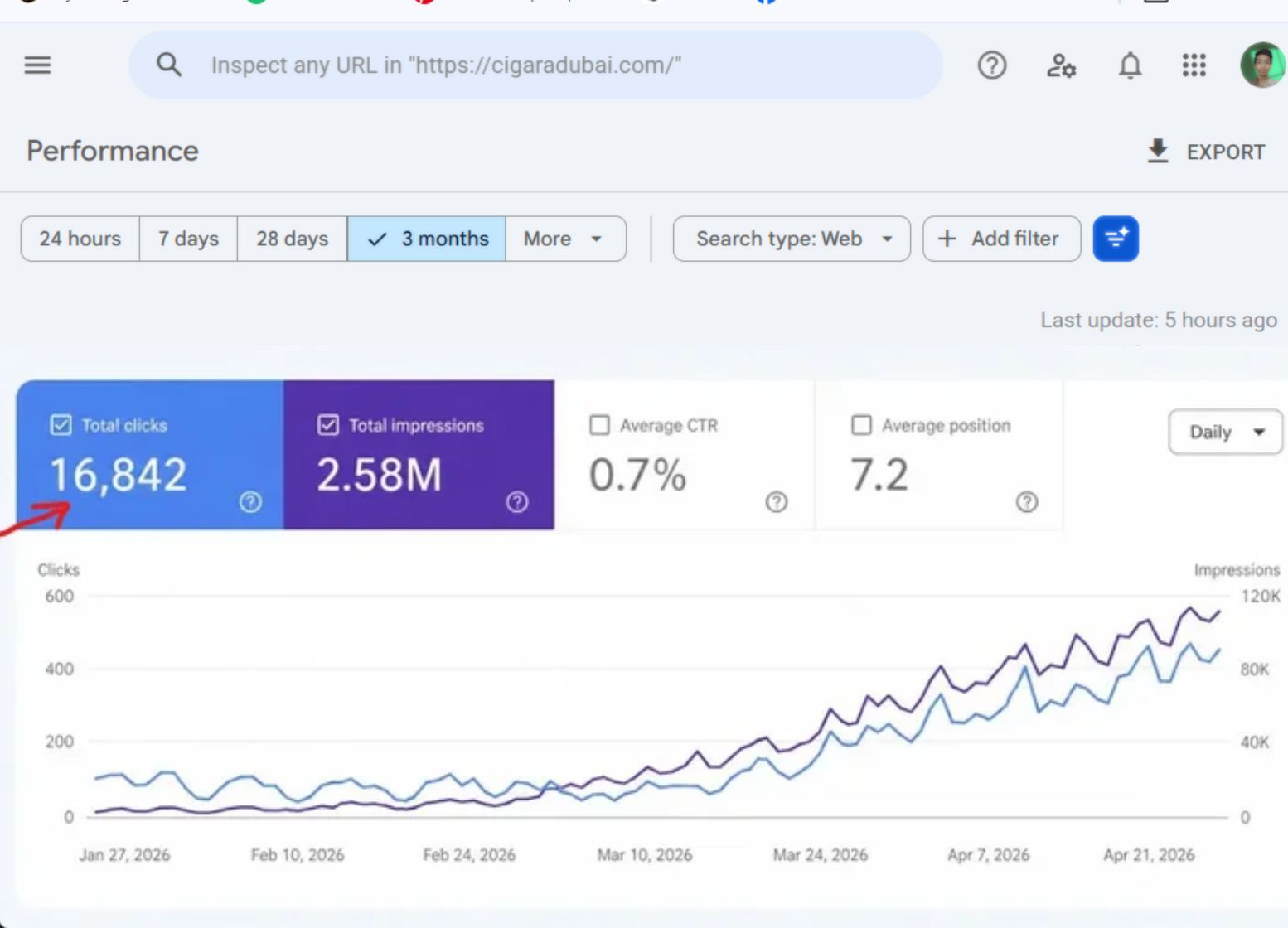
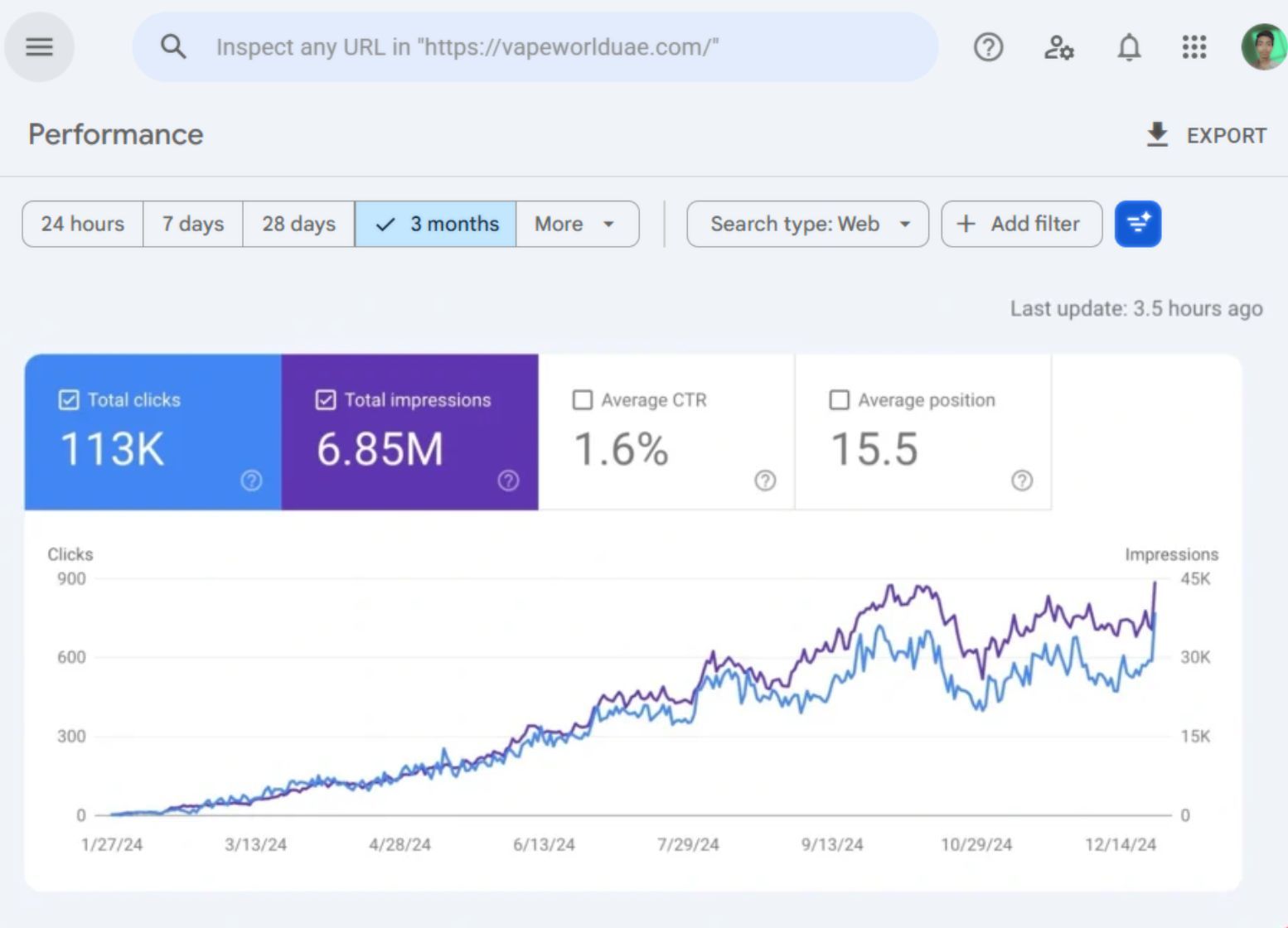
Catalogue-scale ecommerce work, shown in Search Console
The method transfers directly to B2B: template-level changes applied across a whole catalogue, measured
in the client's own Search Console.
UAE WooCommerce store, cigaradubai.com
Technical clean-up, optimised product and category pages, and internal linking rebuilt around the terms customers search for. Search Console showed 16,842 clicks and 2.58 million impressions in a three-month view beginning 27 January 2026.
UAE Shopify catalogue, vapeworlduae.com
Rebuilt collection structure, product-page templates and topical content, so the store could win specific searches across the whole catalogue. Search Console showed 113K clicks and 6.85 million impressions for the period shown.
Why it matters for B2B: a B2B catalogue has the same scale problem. Thousands of products can't be
optimised one by one, so the gains come from templates, data and site structure.
See the full case studiesResults vary with industry, competition, the site's condition and campaign length. No one can guarantee rankings, including us.
B2B ecommerce SEO pricing
Quoted on the work: a 300-product trade store and a 30,000-product distributor are different jobs.
The price depends on your store's condition, how competitive your category is, how much we
implement, and how fast you want to move.
Our prices are hidden. Can B2B ecommerce SEO still work?
Yes. Hidden pricing is normal in trade and doesn't stop a page ranking. It changes the conversion from a purchase to a quote request or account application, so the page needs a clear trade-pricing prompt and quote path instead of an "Add to cart" button.
Should our catalogue be publicly visible?
Usually most of it should. Googlebot can't log in, so a catalogue fully behind a login is invisible to new buyers. Showing product names, part numbers and specifications while keeping account pricing private gives you search visibility without the commercial risk.
Our search volumes are tiny. Is it worth it?
Often, yes. A part number searched 20 times a month can be worth more than a broad term searched thousands of times, if those searchers are buyers ready to open an account. The figure to run is account value, not search volume.
How is this different from your ecommerce SEO and B2B SEO services?
Our ecommerce SEO service covers retail stores with open catalogues and checkout. Our B2B SEO service covers lead generation for B2B service and software companies. B2B ecommerce SEO sits between them: online catalogues sold to trade buyers, with gated pricing and part-number search.
Yes. We're based in Perth and work with businesses across Australia and internationally. Because B2B buyers rarely search with a city name, the work is national by default.
Do you need access to our ERP, PIM or CRM?
Read access helps but isn't essential at the start. Product data quality usually comes from the ERP or PIM, and measuring accounts needs the CRM or order system. We agree exactly what access is needed during the audit.
Can B2B ecommerce SEO help us appear in Google AI Overviews?
It can improve your chances, but no one can guarantee inclusion. Google says there are no extra requirements for AI Overviews beyond standard SEO practice. Clear, crawlable specification and compatibility content is exactly what those answers draw on.
No. Google's own guidance says no one can guarantee a number one ranking. We commit to an agreed scope, a dated change log and reporting from your Search Console and enquiry data.