Enterprise SEO servicesfor large, complex websites
Enterprise SEO is for organisations whose website is too large, complex or shared across teams for standard SEO to work: tens of thousands of URLs, several teams publishing, and developer time that needs a business case.
Our enterprise SEO services cover both halves of the problem: the technical work at scale, and the operating model
that gets that work approved, built, released and protected. You get prioritised, developer-ready tickets, SEO checks
inside your release process, and reporting written for the people who fund it.
Crawl efficiency, indexation control, rendering, internal linking at scale
Content
Write pages
Govern who publishes what, and stop teams competing
Reporting
Rankings and traffic
Revenue contribution, share of search, forecasts vs actuals
Page count alone doesn't make a site "enterprise." A 5,000-page site run by six teams across three countries often needs enterprise SEO more than a 50,000-page site run by one team.
The enterprise SEO operating model
Most enterprise SEO fails in delivery, not strategy. These five parts get the work shipped and keep it shipped.
1
A business case for every major recommendation
Each significant item comes with:
The pages affected
Current traffic and revenue to those pages
A conservative-to-optimistic forecast range
The development effort
The risk of doing nothing
Forecasts are presented as ranges with stated assumptions, never as promises. This is what gets SEO work prioritised against features.
2
Developer-ready tickets
Recommendations arrive in the format your engineers already use:
Problem
Affected templates and URL patterns
Evidence
Proposed fix
Acceptance criteria
How we'll test it
Priority
We write them for Jira, Azure DevOps, ClickUp or whatever your team uses, and we join refinement or sprint planning when it helps.
3
SEO inside your release process
The cheapest SEO fix is the bug that never ships. We add SEO checks to your QA and release process:
A pre-release checklist for templates
Automated checks for status codes, canonicals, noindex, robots rules and titles on key URL samples
Post-release crawl comparison
Problems get caught on staging rather than in Search Console a month later.
4
Content governance
When several teams publish, someone has to decide which page owns which search intent. We set up:
A keyword-to-URL ownership map
Publishing guidelines for non-SEO teams
A process for checking new pages against existing ones before launch
This stops teams cannibalising each other.
5
Clear ownership
We map who is responsible, accountable, consulted and informed for each SEO lever. For example, engineering owns rendering, content owns copy, product owns faceted navigation, and SEO owns the standards and the testing.
Once owners are clear, recommendations stop falling between teams.
What our enterprise SEO services cover
Technical SEO at scale
On large sites, small inefficiencies multiply. We focus on:
Crawl efficiency
Google's crawl budget guide is written for very large or frequently changing sites. If that's you, we identify where Googlebot wastes requests, and redirect that attention to pages that matter.
Log-file analysis
Server logs show which URLs Googlebot actually requests, how often, and what it gets back. This is the only direct view of crawl behaviour, and it's essential at scale.
Indexation control
We decide which page types should be indexed, then enforce that through templates, canonicals, robots rules and sitemaps.
Faceted navigation and parameters
Google's faceted navigation guidance warns that filter URLs can consume crawl capacity and slow the discovery of new content. We define which filter combinations deserve indexable pages.
JavaScript rendering
We check that frameworks such as React, Next.js, Angular or headless builds deliver content, links and metadata that search engines can process.
Core Web Vitals by template
We diagnose performance by page type using field data, so fixes apply to thousands of pages at once.
XML sitemaps at scale
Segmented sitemaps by page type let you monitor indexation by section.
On a large site, internal links decide which pages get crawled and which pages are seen as important. We design:
Linking rules for templates: breadcrumbs, related products, category links and hub pages
Changes so that commercial pages sit fewer clicks from the homepage
Removal of orphaned sections
Content strategy and governance
Topic and keyword ownership across business units
Content audits to prune, merge or improve weak pages
Templates for scaled pages such as locations, products and comparisons, built so each page carries unique, useful information
Google's spam policies target pages mass-produced mainly to rank, so scaled content is only worth building where each page genuinely serves a search. Writing support is available through our SEO copywriting service.
Enterprise ecommerce SEO
Large catalogues bring their own problems:
Variants, colourways and pack sizes
Out-of-stock and discontinued products
Internal search pages
Category and filter sprawl
Product data quality from your PIM or ERP
We set rules that apply across the catalogue, rather than fixing products one at a time. See ecommerce SEO and B2B ecommerce SEO.
Multi-site, multi-region and international SEO
Hreflang across country and language versions
Choice between ccTLDs, subfolders and subdomains
Regional teams' content
Multi-location pages for national brands with many branches
Large brands often have unlinked press coverage, partner relationships and research that could earn links. We turn those into planned authority work through our link building service.
Search visibility in AI answers
Google says there are no special requirements to appear in AI Overviews beyond standard SEO best practice. For enterprise sites, that means:
Crawlable, well-structured pages
Clear entity information about the organisation
Content that answers specific questions accurately
Corporate SEO for different organisations
National retailers and large ecommerce
Catalogue scale, faceted navigation, product data and seasonal peaks.
Multi-location brands
Franchise networks, branches and service areas, with location pages that each carry genuine local information.
Corporate and financial services
Compliance review in the publishing workflow, YMYL content standards and legal sign-off built into timelines.
B2B and industrial
Large product and documentation libraries, long sales cycles and CRM-connected measurement.
Publishers and content-heavy sites
Archive management, crawl efficiency and freshness.
Government, education and not-for-profit
Accessibility, large legacy content estates and multi-department governance.
How an enterprise SEO engagement runs
1
Discovery
We hold stakeholder interviews and review analytics, Search Console, crawl data, logs and your development process. You'll see a map of who owns what and where SEO work gets stuck.
2
Audit and opportunity sizing
We run a full technical, content and competitive audit, then size each opportunity by traffic and revenue at stake.
3
Roadmap and business cases
We produce a prioritised roadmap, with forecast ranges for the major items. It's built to be presented to leadership.
4
Delivery
We write tickets, review sprints, QA on staging, and check releases. Content governance and briefs run alongside.
5
Measurement
We track monthly and report quarterly to leadership, comparing forecast against actual results.
6
Iterate
We re-prioritise each quarter based on what moved and what the business needs next.
What you get
Stakeholder and process map
Who owns each SEO lever, and where work currently stalls
Enterprise SEO audit
Technical, content, architecture and competitive findings, grouped by root cause
Opportunity sizing
Traffic and revenue at stake for each major issue
Prioritised roadmap
Impact, effort and dependencies, by quarter
Business cases
Forecast ranges and assumptions for leadership approval
Developer tickets
Acceptance criteria and test plans in your ticketing system
Operational detail for teams, and a business summary for executives
Reporting for two audiences
Monthly
For the working team
Indexation by page type
Crawl and log trends
Release QA results
Ticket status
Search Console performance by section
Quarterly
For leadership
Organic revenue or leads contribution
Share of search against named competitors
Forecast vs actual results for shipped work
Risks
Next quarter's priorities and the investment they need
Data comes from your own Search Console, analytics and logs. We don't use a black-box score.
Engagement models
Enterprise SEO consulting
Best forOrganisations with an in-house SEO team
How it worksSenior strategy, audits, business cases and escalation support for your team
Embedded SEO partner
Best forIn-house teams that need more hands
How it worksWe work in your tools and ceremonies alongside your marketers and developers
Managed enterprise SEO
Best forOrganisations without in-house SEO
How it worksWe run strategy, technical, content and reporting end to end, and coordinate your developers
Project
Best forMigrations, replatforms, audits
How it worksA fixed scope with a defined end point
Enterprise SEO consultant, agency or in-house team?
In-house teams, independent consultants and enterprise SEO firms each solve a different part of the problem.
Factor
In-house SEO
Enterprise SEO consultant
Enterprise SEO agency
Strength
Deep business knowledge, always available
Senior judgement and objectivity
Capacity across technical, content and links
Limitation
Hard to hire, and one person can't cover everything
Limited hands for execution
Can be slow and generic if poorly run
Best for
Day-to-day ownership
Strategy and unblocking
Delivery at volume
Most organisations need a mix. We work as a consultant, an embedded partner or a managed team, depending on what you already have.
Enterprise SEO from Perth, for brands across Australia
We're based in Perth and work with organisations across Australia and internationally. Enterprise SEO doesn't depend on location. The work happens in your analytics, your codebase and your release process, and meetings run on video in your time zone.
Perth and WA organisations, and Melbourne, Sydney and Brisbane teams, work with us the same way. City-level SEO is
covered on our Melbourne, Sydney
and Australia-wide pages.
Catalogue-scale results
The template-level, catalogue-scale method that enterprise work relies on.
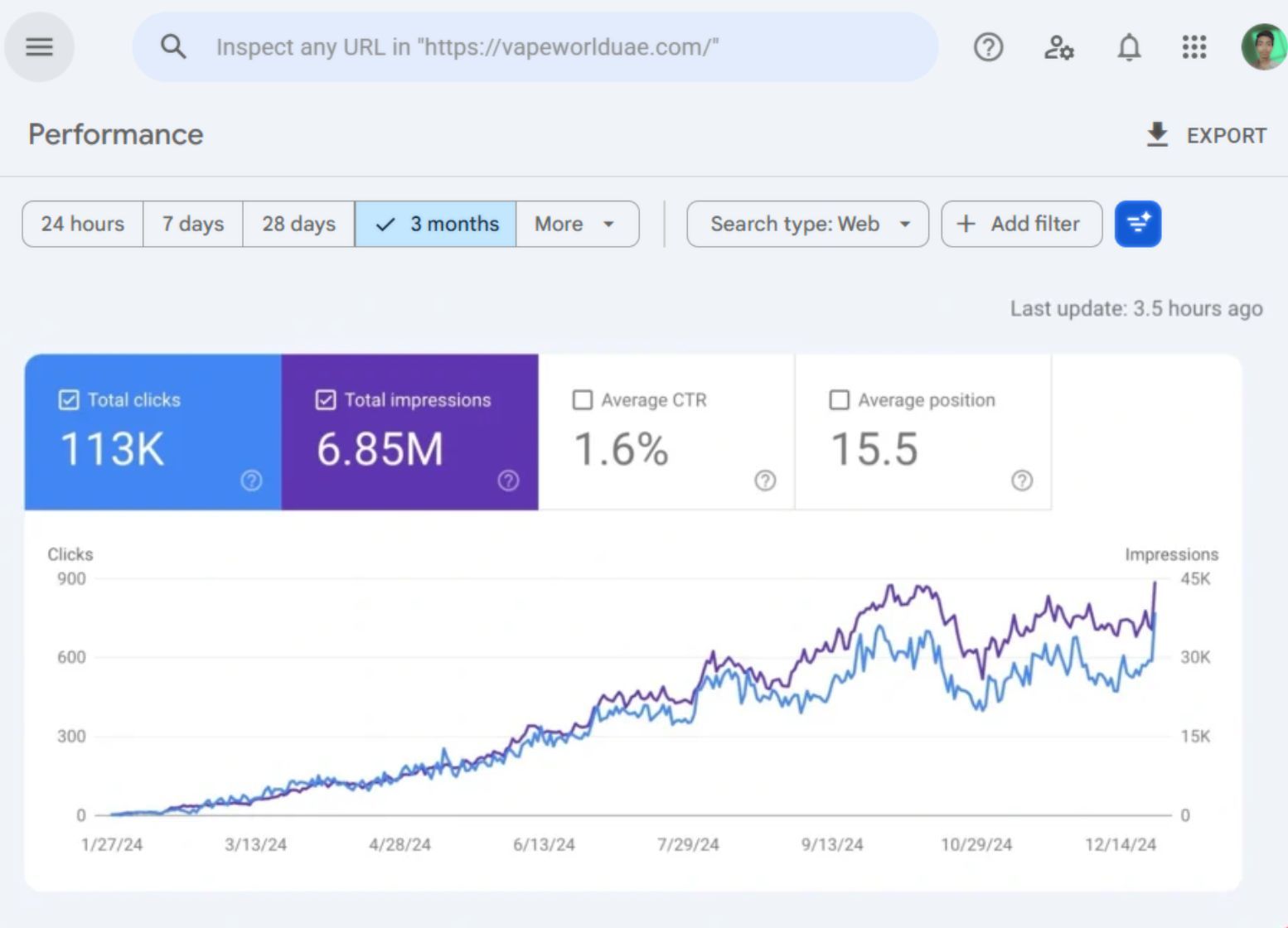
vapeworlduae.com · Shopify · UAE
UAE Shopify catalogue
Work
Collection structure and product-page templates rebuilt across the catalogue.
Result
113K clicks and 6.85M impressions in Search Console for the period shown.
Organisations that can't give SEO any developer time
Anyone expecting guaranteed rankings or fixed traffic numbers
Enterprise SEO pricing
Enterprise SEO is scoped individually, based on:
Site size and complexity
Sites, regions or brands
Delivery vs advice
Who handles dev and content
Engagement length
Consulting and embedded work runs on monthly retainers; migrations and audits are fixed-scope projects. You get a written proposal after discovery. See SEO packages and pricing for our standard services.
How long does enterprise SEO take?
Discovery, audit and roadmap come first. The first technical fixes ship once they're approved and scheduled into your sprints. Measurable search impact depends on how quickly your organisation releases changes, which is why we focus so heavily on the delivery process.
Large structural changes, such as architecture, migrations and international restructures, play out over quarters, not weeks.
Enterprise SEO FAQs
What are enterprise SEO services?
Enterprise SEO services cover strategy, technical SEO, content and governance for large, complex websites. They also cover getting SEO work prioritised, built and protected across the teams that own the site.
What's the difference between enterprise SEO and regular SEO?
The ranking principles are the same. Enterprise SEO works at template and system level rather than page by page, and it deals with stakeholders, release cycles, business cases and governance that smaller sites don't have.
How big does a website need to be for enterprise SEO?
There's no fixed number. Size matters, but complexity matters more: multiple teams, sites, regions or platforms, and changes that need developer time and approval.
Do you work with in-house SEO teams?
Yes. Many engagements support an existing team with senior strategy, extra capacity, technical depth or help building business cases.
Do you work directly with our developers?
Yes. We write tickets in your system, join refinement or sprint planning when useful, and QA changes on staging before release.
Which platforms do you work with?
Enterprise ecommerce and content platforms, plus custom and headless builds.
Can you forecast the impact of SEO work?
Yes, as ranges based on current traffic, conversion data and stated assumptions. Forecasts help prioritise work, and we compare them against actual results after release. They aren't guarantees.
Do you provide enterprise SEO in Melbourne and Sydney?
Yes. We're based in Perth and work with organisations across Australia and internationally, with meetings on video in your time zone.
Is enterprise ecommerce SEO different?
Yes. Catalogue scale, variants, filters, out-of-stock handling and product data quality all need rules that work across thousands of products.
Can you guarantee rankings?
No. No one can honestly guarantee rankings. We commit to a clear scope, a prioritised roadmap and transparent reporting.
How much do enterprise SEO services cost?
It's scoped individually, based on site complexity, number of sites and how much we deliver versus advise. You receive a written proposal after discovery.
Get organic search working at the scale of your business
Book a consultation, or send us your domain and a short note on what's stuck. We'll review the site first, then come back with where we think the biggest opportunity is and what it would take to ship it.